

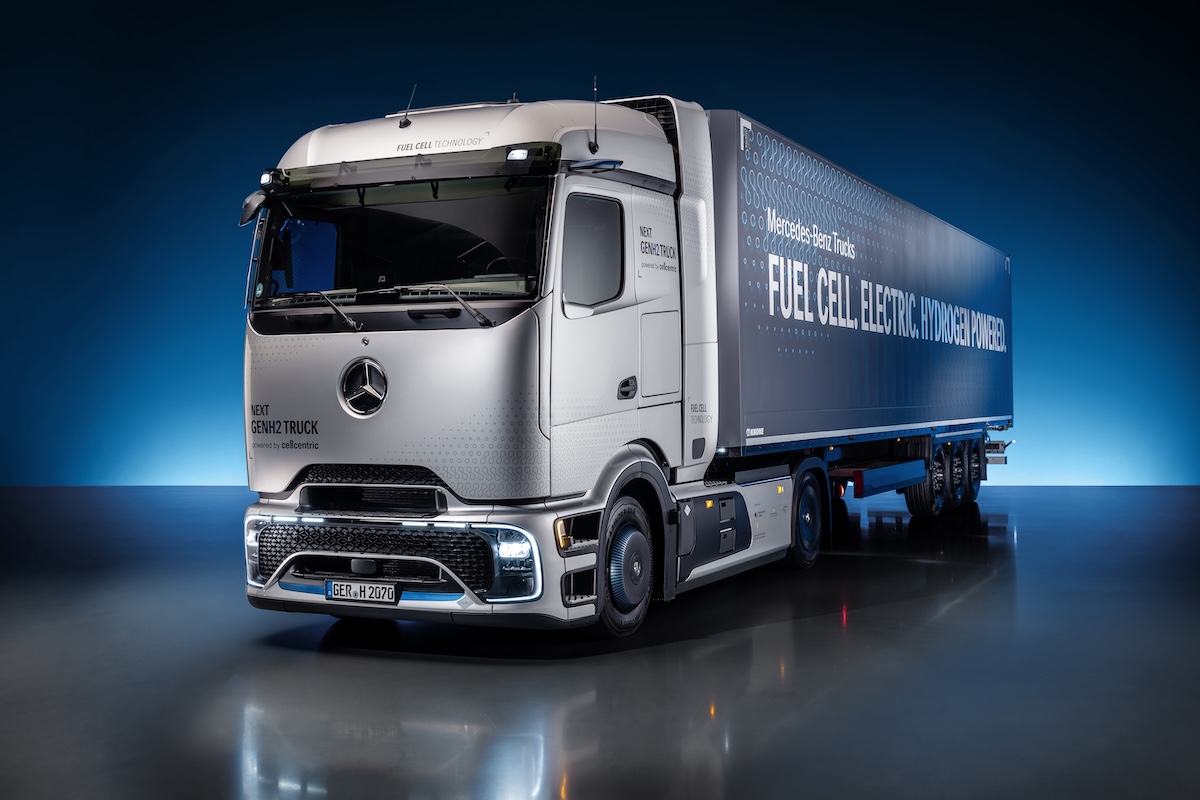
Big news for the movement towards alternatively fuelled trucking around the world this week with Daimler Truck in Europe announcing plans to have 100 Mercedes-Benz NextGenH2 Trucks with customers from late 2026.
The trucking giant has committed to small-run production of the trucks which have been proven under test conditions to be capable of up to 1,000km on a single tank of hydrogen, even under load.
The NextGenH2 Trucks include key components of Mercedes-Benz battery electric eActros 600, such as the integrated e-axle, the aerodynamically optimised ProCabin, the MultiMedia Cockpit 2 and the latest safety systems.
It will also have updates to the cellcentric fuel cell and liquid hydrogen technology found in the first generation hydrogen truck.
While it’s big news for freight haulers in Europe, it’s not likely we’ll see the trucks on Australian roads anytime soon.
Daimler Truck Australia Pacific Vice President Sales, Marketing and Operations, Andrew Assimo, says while it is exciting to see the news about the NextGenH2 introduction overseas, it’s a case of watch and see here.
“The start of the Mercedes-Benz NextGenH2 production for European markets represents a major milestone for sustainable trucking,” Assimo says.
“We have no immediate plans for its introduction in Australia, but that is certainly something we will consider as we watch its roll-out across Europe.”
Mercedes-Benz Trucks CEO Achim Puchert says the technology is part of the mix when it comes to finding lower carbon solutions to suit the transport task.
“In addition to battery-electric solutions, hydrogen-based drives are crucial for the sustainable transformation of our industry,” Puchert says.
“With the NextGenH2 Truck, we are taking the next technological step in fuel cell trucks. Together with our customers, we aim to introduce a small series with high range and near production ready technology into daily transport operations from the end of 2026.”
The small-series production run will be undertaken at the Mercedes-Benz plant in Wörth.
In a statement on the new series of trucks, Daimler says it prefers the use of liquid hydrogen for its ability to be stored.
“At -253 degrees Celsius, liquid hydrogen has a significantly higher energy density compared to gaseous hydrogen, allowing more hydrogen to be stored, substantially increasing range and delivering performance comparable to conventional diesel trucks,” the statement says.
“The capacity of the two liquid hydrogen tanks has been increased compared to the first generation of the Mercedes-Benz GenH2 Truck, so that a total of up to 85 kg of hydrogen can now be filled.
“Refuelling is possible from both sides as both tanks are connected. Using the sLH2 refueling standard developed by Daimler Truck and Linde, the truck can be filled with liquid hydrogen within 10–15 minutes — as safe, fast, and simple as refuelling today’s diesel trucks.”
A GenH2 Truck recorded 1,047km on a single fill up of liquid hydrogen at the end of 2023 as part of Daimler Truck’s #HydrogenRecordRun. The truck beat the 1,000km mark with a total gross combined vehicle weight of around 40 tonnes.
Customer trials of the Mercedes-Benz GenH2 Truck provided valuable feedback for improvements in the NextGenH2 Truck, including a change to the space behind the cab which is now more compact, allowing the wheelbase of the new truck to be 150 mm shorter, which in turn brings greater flexibility in trailer combinations within EU length regulations.
The development, production, and practical deployment of the NextGenH2 Trucks scheduled from the end of 2026 is supported by the German Federal Ministry of Transport (BMV) and the federal states of Rhineland-Palatinate and Baden-Württemberg with in total €226 million.
Series production of fuel cell trucks is targeted for the early 2030s.
STORY WITH THANKS TO ATN MAGAZINE